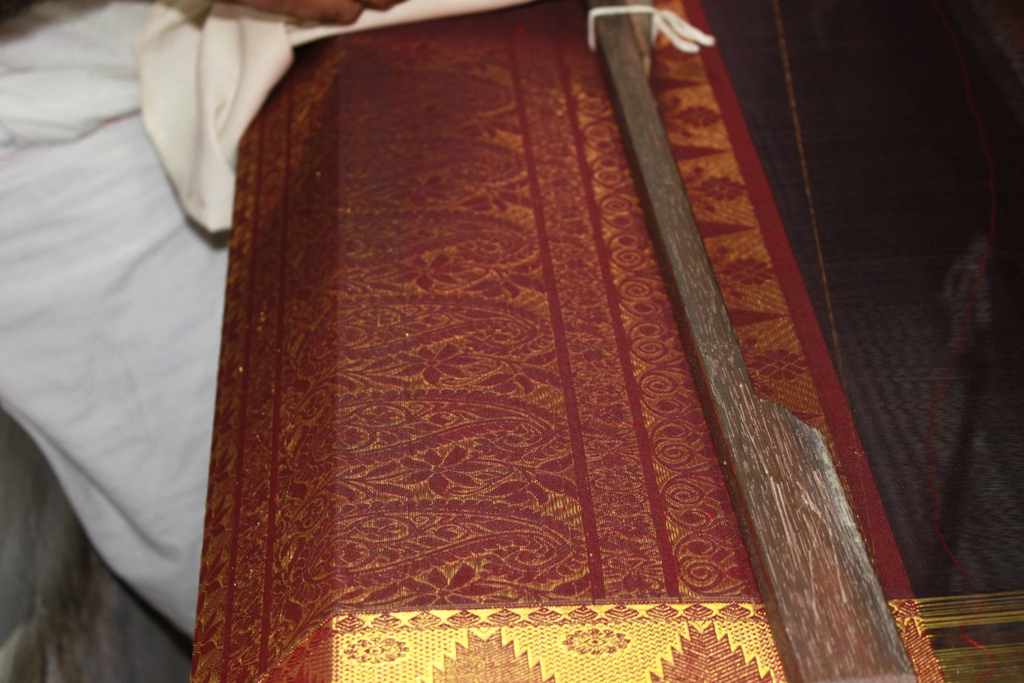
A Kanchipuram is best understood through several pieces of evidence. No single visual feature proves every claim.
Begin with the place
Kanchipuram, also written Kancheepuram, is a weaving centre in Tamil Nadu. Its silk sarees are closely associated with weddings and special occasions. The registered geographical indication is named “Kancheepuram Silk”. A familiar colour combination alone does not establish where a saree was made.
Learn to see the structure
Start with the large field of the body, the borders running along its edges, and the decorative end called the pallu. Look at how the design changes between them. In traditional examples, colour and weaving structure give each part its own presence.
Three questions worth keeping
Use a description as the start of a conversation. Ask about the weaving place, the exact silk and zari materials, and the production method. Record the answers against the particular piece you are viewing. A shop’s reputation and a product’s documentation are useful for different reasons.
- Where was this particular saree woven, and who made it?
- What are the declared fibre and zari compositions?
- What evidence accompanies the handloom and origin claims?
Build your own eye
Open the saree fully before deciding. Look once from a distance for balance, then up close for construction and finish. Finally, try the drape if permitted. This sequence gives you a more useful impression than a single folded product photograph.
Compare traditions without relying on a silhouette
If you are choosing between regional sarees, begin with a full view and a written description of each. A contrasting border or an ornate pallu can prompt a useful construction question, but the appearance alone cannot settle the weaving location. Ask the seller to explain the named technique and connect the description to the selected item.
Sources & further reading
References support the passages where they are cited. Comparison worksheets, shopping questions and planning examples are practical editorial guidance.