Motif names and interpretations vary between makers. Record the name used for the actual piece.
Borrowed from the world around the loom
The documented vocabulary includes temple-inspired forms, plants, birds, and geometric patterns. NID’s account names mayilkan, or peacock’s eye; rudraksham, based on rudraksha beads; and a jasmine motif. It also records checks and stripes as part of the design language.
Look at shape before symbolism
Begin with what you can see: a repeated curve, an eye-like form, a flower, or a row of small geometric elements. Ask the maker for the local name. Spellings and usage can differ, and a form may have more than one interpretation.
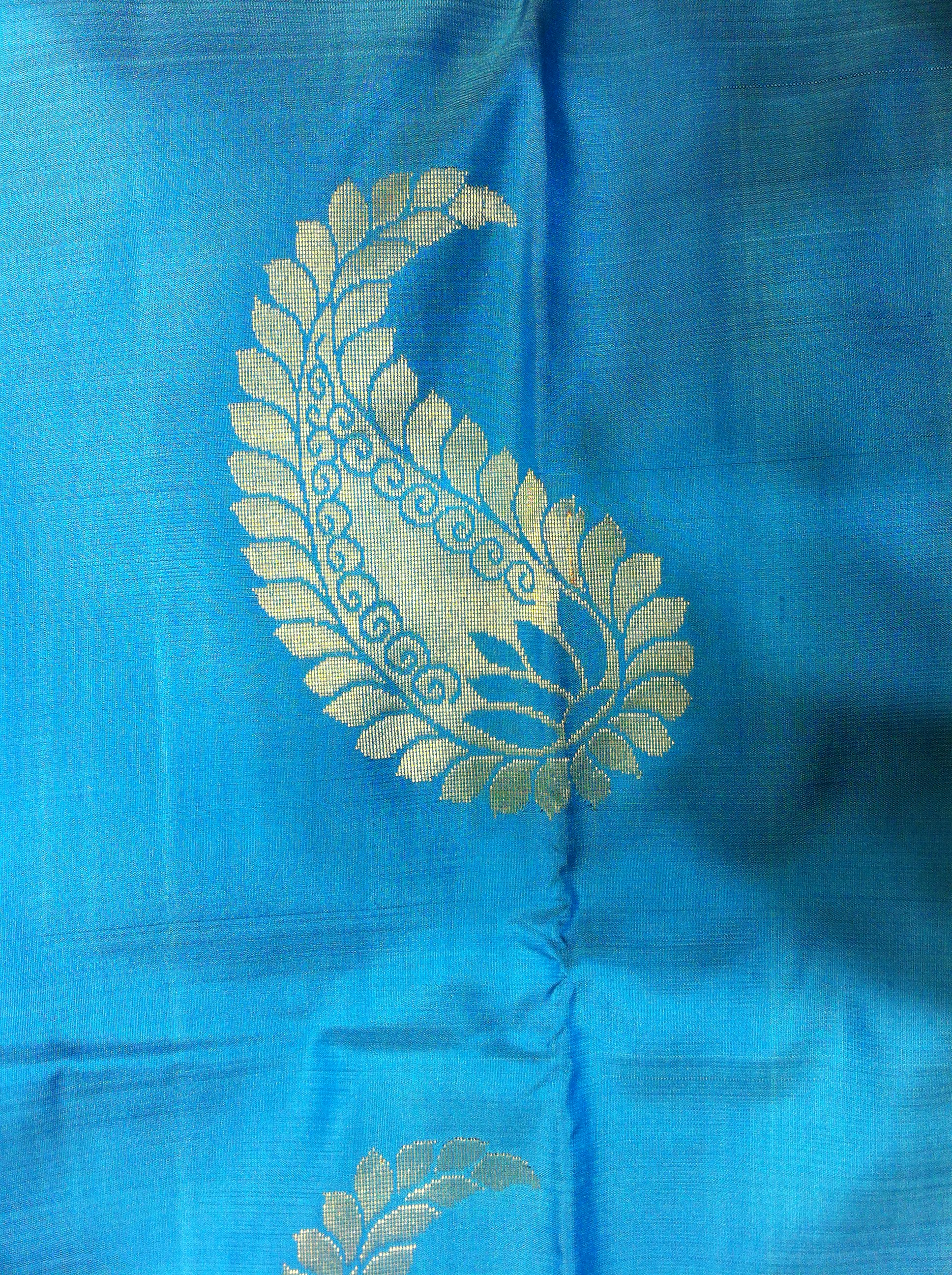
A mango in blue and gold
The archival photograph shown here records a maanga, or mango-shaped, motif on a Kanchipuram saree. Follow the contour and the smaller decorative details inside it. One motif can feel very different when its size, repetition, background colour, or border changes.
Keep the story attached to its source
When recording a meaning, distinguish the maker’s explanation from a general association you have heard elsewhere. Avoid assigning a single fixed spiritual meaning to every occurrence of a motif. Describing a pattern accurately is already a way to appreciate it.
- What does this workshop call the motif?
- Is it an inherited pattern or a new interpretation?
- Where else does the same form appear on the saree?
Sources & further reading
References support the passages where they are cited. Comparison worksheets, shopping questions and planning examples are practical editorial guidance.